
One-Page Business Plan: How to Write One (With Template)

A one-page business plan (sometimes called a simple business plan or a lean business plan) is a short summary of your business on a single page: what you offer, who it is for, how you will reach them, how the numbers work and what you will do next. It is quick to write, easy to share and easy to update, which makes it a good starting point for a new idea or a simple way to keep an existing business on track.
Key takeaways
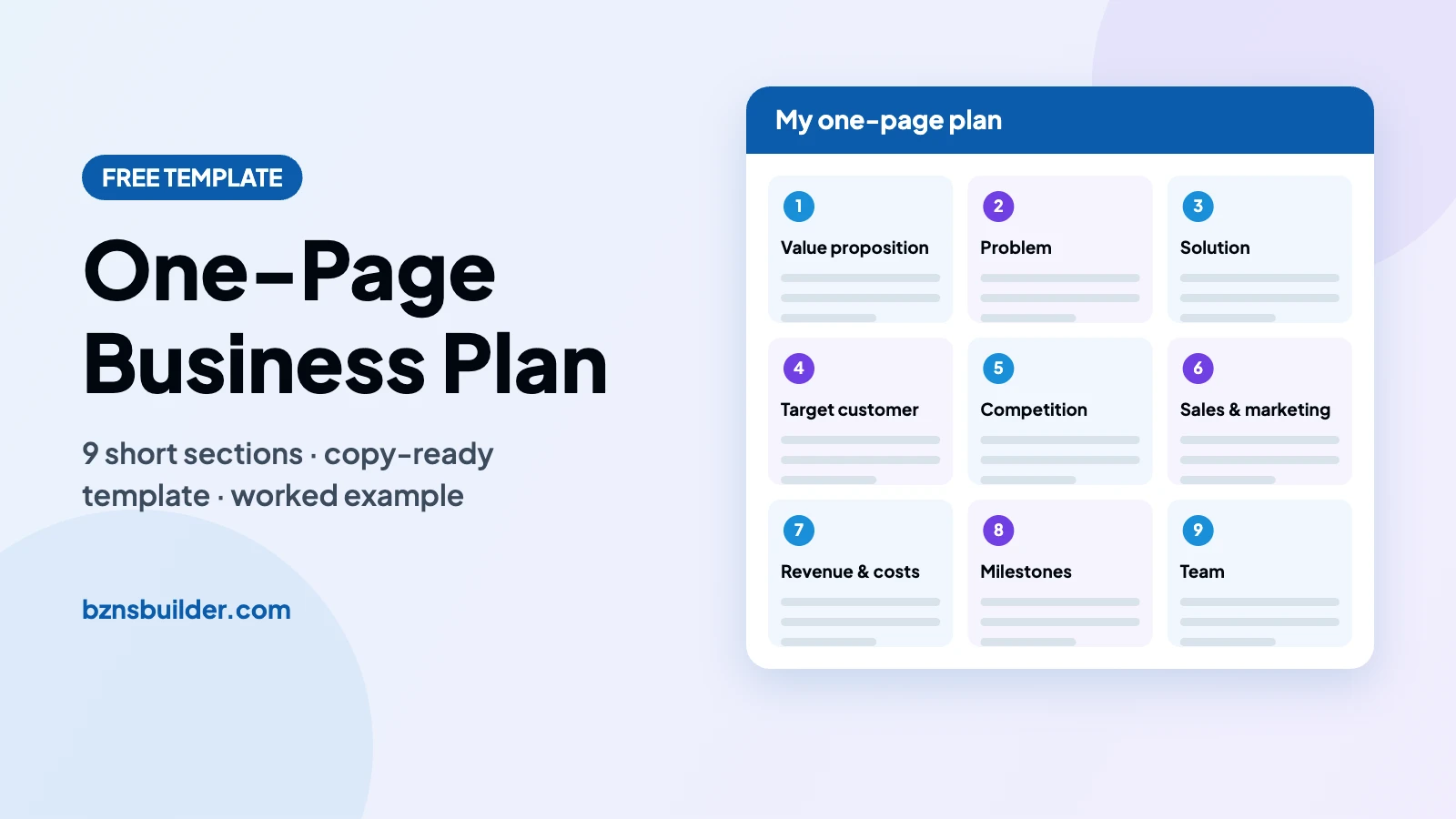
- A one-page plan covers nine essentials: value proposition, problem, solution, target customer, competition, sales and marketing, revenue and costs, milestones and team.
- It is a working document. Review it regularly and update it as you learn.
- It is not a replacement for a full plan when a bank, investor or grant programme asks for one.
- The template below can be copied straight into a document or spreadsheet.
- Need the full version? Use our free business plan template (Word or PDF, 10 sections).
What is a one-page business plan?
A one-page business plan condenses the core of a business plan into one page. Instead of long sections, each part is answered in one to three sentences or a few bullet points.
The goal is clarity, not completeness. Writing on one page forces you to decide what really matters: the customer you are serving, the problem you solve and the few numbers that tell you whether the business can work.
One-page plan, lean business plan and Lean Canvas: what’s the difference?
These terms are often used together, but they are not the same thing:
- One-page business plan is a format: a short written summary of the business that fits on one page.
- Lean planning is a process: you keep the plan short, test your assumptions and update the plan often based on what you learn.
- Lean Canvas and Business Model Canvas are visual tools: boxes on a single grid that map the business model. They are useful for exploring a model, but usually say less about milestones, team and cash. See What Is the Canvas Business Model?
A one-page plan works well as the written output of a lean planning process.
When is a one-page plan enough?
A one-page plan is usually enough when you:
- are testing a new idea and want to check that it makes sense;
- need to align co-founders or a small team on priorities;
- want a quick summary to share with a mentor, advisor or partner;
- run an existing business and want a simple plan to review each month or quarter.
You will usually need a fuller plan when:
- a bank, investor, accelerator or grant programme asks for one;
- the business depends on significant upfront investment;
- you need detailed financial forecasts, such as a profit and loss forecast, cash-flow forecast and balance sheet.
In those cases, use the one-page plan as your outline and expand it with our step-by-step guide on how to write a business plan. For background on what a full plan contains, see What Is a Business Plan?
One-page business plan template
Copy this table into a document or spreadsheet and replace the prompts with your own answers. The example column shows a fictional business.
| Section | What to write | Example: weekday meal-prep delivery (fictional) |
|---|---|---|
| 1. Value proposition | One sentence: what you offer, for whom, and the main benefit. | Healthy, ready-to-heat weekday lunches delivered to busy office workers, so they eat well without cooking. |
| 2. Problem | The specific problem or need your customer has today. | Office workers want healthy lunches but have little time; nearby options are mostly fast food or expensive. |
| 3. Solution | What you sell and how it solves the problem. | A weekly subscription of five lunches, cooked on Sunday and delivered Monday morning. |
| 4. Target customer | Who buys first. Be specific about location, type and budget. | Employees aged 25–45 in two business districts, mid-range budget, ordering for themselves. |
| 5. Competition and alternatives | What customers use today and why they would switch to you. | Restaurant delivery apps, home cooking, office canteens. Cheaper per meal than delivery apps and healthier than fast food. |
| 6. Sales and marketing | How customers find you and how they buy. | Instagram and office WhatsApp groups; free tasting days at partner offices; ordering by online form. |
| 7. Revenue, costs and break-even | How you make money, your main costs and the sales you need to cover them. | Weekly subscription price per customer; main costs are ingredients, kitchen rent and delivery. Break-even target: a set number of active subscribers per week. |
| 8. Milestones | Three to five dated goals for the next 3–12 months. | Month 1: 20 paying subscribers. Month 3: second business district. Month 6: hire a second cook. |
| 9. Team | Who does what, and which skills are missing. | Founder: cooking and operations. Co-founder: sales and delivery. Gap: part-time bookkeeping. |
How to fill in each section
1. Value proposition
Write one sentence a customer would understand immediately. If you need jargon to explain it, simplify it. Test it by reading it to someone outside your industry.
2. Problem
Describe the problem from the customer’s point of view, not yours. The best evidence comes from talking to potential customers: what do they struggle with today, and what have they already tried?
3. Solution
Explain what you sell and how it solves the problem you just described. Keep the focus on the outcome the customer gets, not on every feature.
4. Target customer
Name the first group you will sell to. “Everyone” is not a target market. A narrow, reachable first segment makes your marketing cheaper and your message clearer.
5. Competition and alternatives
List what customers do today instead of buying from you, including doing nothing. Then state, in one line, why a customer would switch.
6. Sales and marketing
Name the two or three channels you will actually use, and how a sale happens: online checkout, a sales call, a shop visit or a contract. Choose channels you have the budget and skills to run.
7. Revenue, costs and break-even
Write how you charge (per item, per subscription, per project), your largest costs, and roughly how many sales you need to cover them. Rough numbers are fine at this stage. What matters is that the assumptions are written down so you can test them.
8. Milestones
Pick three to five goals with dates, such as a first paying customer, a launch, a key hire or a sales target. Give each one an owner if you have a team.
9. Team
List who is responsible for what, and the skills you still need. Gaps are normal; naming them shows you know what to solve next.
Keep the plan current
A one-page plan is most useful when you return to it. Set a regular review, monthly for a new business or quarterly for an established one, and ask:
- Did sales and costs match what we expected?
- Is our target customer behaving as we assumed?
- Which milestones did we hit or miss, and why?
Update the page with what you learned. Over time, it becomes a clear record of how your business and your thinking have changed.
From one page to a financial forecast
Section 7 is where most one-page plans stay vague. When you are ready to turn those rough numbers into a forecast, BznsBuilder supports guided business plan creation, financial forecasting and what-if scenarios, so you can see how changes in price, sales or costs affect profit and cash. Explore the BznsBuilder business plan builder.
Frequently asked questions
How long should a one-page business plan be?
One page. Keep each section to one to three sentences or a few bullet points.
Can I raise funding with a one-page plan?
It can start a conversation with a mentor or an early investor, but most banks and investors will ask for a full plan with detailed financials.
Is a one-page business plan the same as a Lean Canvas?
No. A Lean Canvas is a visual grid for mapping a business model. A one-page plan is a short written summary that also covers milestones, team and next steps.
What is the difference between a simple business plan and a full business plan?
A simple business plan covers the essentials on one page so you can decide and act quickly. A full business plan adds detailed market analysis, operations and financial statements, which lenders and investors usually expect.
How often should I update my one-page plan?
Review it at least every quarter, and whenever something important changes, such as pricing, a new customer segment or a funding decision.