
How to Validate a Business Idea Before You Invest: 5 Steps

Business idea validation is the process of testing, with real customers, whether people want your product or service enough to pay for it, before you spend serious money. In five steps: write the idea on one page, list your assumptions, test the riskiest one cheaply, judge the result against a rule you set in advance, and check whether the numbers can work.
Key takeaways
- Validate the assumption most likely to kill the idea first, not the easiest one.
- Commitments (deposits, pre-orders, signed pilots) count far more than compliments or survey answers.
- Decide what “pass” means before you run the test.
- A passed test still needs numbers: how many customers you need to break even, and whether you can reach them.
What is business idea validation?
Validation answers one question: will enough of the right customers pay for this, at a price that works? It sits between having an idea and committing money to it.
| Idea validation | Market research | Feasibility study | |
|---|---|---|---|
| Question | Will customers commit? | How big is the market and who competes? | Can the whole project work financially, technically and legally? |
| Evidence | Interviews, sign-ups, pre-orders, pilots | Reports, statistics, competitor data | Costs, revenue model, cash flow, break-even, payback |
| Time and cost | Days to weeks, low cost | Days, low to medium cost | Weeks, medium cost |
| Comes | First | Alongside validation | After validation passes |
How to validate a business idea in 5 steps
1. Write the idea on one page
In six short lines: the customer, their problem, your solution, the price, how customers will find you, and what it costs to deliver. A one-page business plan is enough. If you can’t fill a line, that gap is your first question.
2. Turn each line into an assumption and pick the riskiest
Rewrite each line as something that could be false: “Office managers struggle to keep healthy snacks stocked”, “They’ll pay a monthly fee”. Rank them by how badly the idea fails if the assumption is wrong. Test the top one first.
3. Run the cheapest test that could prove it wrong
Talk to customers before you build anything. Then move to tests that ask for a commitment: a landing page with a sign-up, a deposit, a paid pilot. The table below helps you choose.
4. Set the pass rule before you start
Write it down: “We continue if at least 5 of 120 contacted offices agree to a paid pilot at our target price.” A rule written afterwards will always find a reason to pass.
5. Check whether the numbers can work
A test tells you the conversion rate. The numbers tell you whether that rate is enough: how many customers you need to cover fixed costs, and how many people you’d have to reach to get them. The calculator below does this in one step.
Which validation test should you run?
| Test | What it proves | Typical cost | Strength of evidence |
|---|---|---|---|
| Problem interviews (10–15 people) | The problem is real and how they solve it today | Time only | Low to medium: words, not money |
| Landing page + sign-up | People will act on your promise | Small ad budget | Medium |
| Pre-order or deposit | People will pay at your price | Low | High |
| Paid pilot / small batch | You can deliver, and customers come back | Low to medium | Highest |
| Survey only | What people say they might do | Very low | Weak on its own |
In interviews, ask about the past, not the future: “When did this last happen? What did you do? What did it cost you?” People are polite about ideas and honest about their own habits.
A worked example: a B2B service
Say a B2B company wants to sell a monthly healthy-snack service to offices at $150 per office per month. Its riskiest assumption: office managers will pay a monthly fee rather than buy snacks themselves.
- Test: contact 120 offices with a one-page offer and a two-week paid pilot. Test budget: $200.
- Pass rule (set in advance): at least 5 offices agree to a paid pilot at the full price.
- Result: 6 offices sign up (5%). The rule is met.
- Numbers check: after direct costs, each office leaves $60 a month (a 40% margin). Fixed costs are $1,200 a month, so the company needs 20 offices to break even. At a 5% sign-up rate, it has to reach about 400 offices.
So the test passed, but the real question changes: can the company reach 400 offices at an acceptable cost? That becomes the next assumption to test. The numbers are illustrative.
Validation test calculator
Enter your own test result. The calculator shows your conversion rate, the customers you need to break even, and how many people you’d need to reach.
Pass, pivot or stop: reading the results
| What you see | What it usually means | Next move |
|---|---|---|
| Pass rule met, numbers work | The riskiest assumption held | Test the next riskiest assumption, then move to a feasibility study |
| Interest but no commitment | The problem is real; the offer or price isn’t right | Change one thing (price, package, customer group) and re-test |
| Commitment, but the numbers don’t work | The business model needs to change | Raise the price, cut costs or find a cheaper channel, then re-run the numbers |
| Little interest from any group | The problem isn’t painful enough | Stop, keep what you learned, and generate new options |
Stopping early is a good result: it cost you a test, not your savings.
After validation: feasibility, plan and forecast
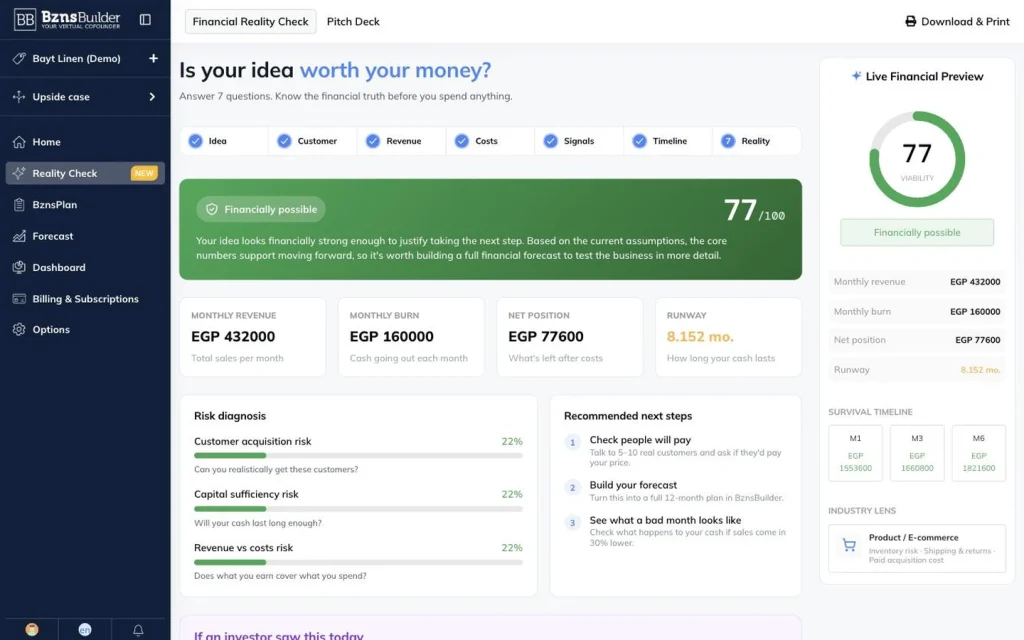
Once your riskiest assumption passes, check the whole idea. BznsBuilder’s Reality Check takes you through seven short steps (the idea, customer, revenue, costs and timing) and compares your answers with typical figures for your industry. It rates six signals, including demand, pricing, customer acquisition and cash runway, and gives you a viability score out of 100 with your main risks and next steps. It tells you whether the numbers justify the next step. Your test results tell you whether customers do.
Run a Reality Check on your idea, free for 7 days with no credit card, or see it in the 2-minute product tour. Then write it up with the free business plan template and check the break-even point.
Frequently asked questions
How do I validate a business idea?
Write the idea on one page, turn it into assumptions, test the riskiest one with real customers (ideally asking for a commitment such as a deposit or paid pilot), judge the result against a rule you set beforehand, then check how many customers you need to break even.
How can I test a business idea without spending much money?
Start with 10–15 problem interviews, then a simple landing page or offer that asks for a sign-up or deposit. A small paid pilot gives the strongest evidence for the least money.
How many customer interviews do I need?
Many founders start with 10–15. Stop when you keep hearing the same answers, and remember that interviews show the problem is real but don’t prove people will pay.
Is a survey enough to validate an idea?
Not on its own. Surveys record what people say they might do. Commitments like pre-orders, deposits or signed pilots show what they actually do.
What is the difference between idea validation and a feasibility study?
Validation tests whether customers want the idea. A feasibility study comes after and checks whether the whole project works financially, technically and legally.
How long does validation take?
Usually a few days to a few weeks per assumption. Test the riskiest assumption first so you learn the most in the least time.
Test your idea’s numbers before you invest
See if it can make money, in minutes.
- P&L
- Cash flow
- Scenarios