Should I Offer Longer Payment Terms to Win a Bigger Contract?

A bigger contract is not automatically a better deal for your cash flow.
If winning it means giving the customer longer to pay, the contract may ask your business to fund delivery for weeks or months before the cash arrives.
So before you agree, answer one question:
What is the lowest cash balance this contract creates before the customer pays — and can the rest of your business safely operate through that point?
The contract value matters. So does the margin. But neither tells you whether you can fund the timing.
The bigger contract can be attractive and still be hard to fund
Suppose a customer offers you a larger order, but wants more time to pay.
Commercially, that can look attractive. You get more revenue and perhaps a worthwhile return on the work.
Cash can tell a different story.
You may have to pay suppliers, buy materials, add temporary capacity or cover delivery costs before the customer settles the invoice. The longer the customer has to pay, the longer your business carries that gap.
This is the same cash-timing mechanism behind the broader question of why sales can rise while cash falls. If you want the full explanation, see Sales Are Up. So Why Is Cash Going Down?.
For this decision, however, the important point comes before the sale:
Can you afford the payment terms you are about to offer?
What longer payment terms actually change
Longer terms do not make the invoice smaller. They change when the cash becomes available to your business.
Imagine that two versions of the same contract require the same delivery work.
In both versions, you incur the same stated delivery costs. But in one, the customer pays relatively soon. In the other, the customer pays much later.
The final cash contribution from the simplified contract may be identical once the invoice is collected.
The path to that point is not.
That path matters because your business still has payroll, suppliers, rent, tax obligations and existing customers to support while you wait.
Illustrative example: the contract works, but cash gets tight first
Illustrative example only. These figures are fictional and are not benchmarks or typical payment terms for Egyptian SMEs.
An Egyptian B2B company starts with EGP 800,000 in cash.
It is considering a contract worth EGP 1,200,000.
To deliver it, the company expects to pay:
- EGP 432,000 in Month 1;
- EGP 288,000 in Month 2.
That is EGP 720,000 of stated delivery cash costs.
To isolate the timing decision, assume no tax, financing cost, overhead or other business cash flows in this example.
Now compare three simplified paths:
| Scenario | Start | Month 1 | Month 2 | Month 3 | Month 4 |
|---|---|---|---|---|---|
| No contract | EGP 800,000 | EGP 800,000 | EGP 800,000 | EGP 800,000 | EGP 800,000 |
| EGP 1.2m contract, customer pays after about 30 days | EGP 800,000 | EGP 368,000 | EGP 1,280,000 | EGP 1,280,000 | EGP 1,280,000 |
| EGP 1.2m contract, customer pays after about 90 days | EGP 800,000 | EGP 368,000 | EGP 80,000 | EGP 80,000 | EGP 1,280,000 |
Once collected, the simplified contract adds EGP 480,000 of cash after the stated delivery costs:
EGP 1,200,000 − EGP 720,000 = EGP 480,000
That is not a claim about accounting profit. The example excludes overhead, tax, financing and other cash flows.
The decision problem is visible in Month 2.
With the later payment, the company’s cash falls to EGP 80,000 before it recovers.
If this were the company’s only commitment, that might be manageable.
But real businesses have other obligations. If normal payroll, supplier bills and operating commitments need more than that remaining EGP 80,000, the contract creates a funding problem before it creates the expected cash benefit.
The question is therefore not simply:
“Does this contract make money?”
It is also:
“Can we survive the cash path required to earn it?”
Six questions to answer before agreeing to longer terms
1. What must you pay before the customer pays you?
List the cash commitments created by the contract.
Depending on the work, that might include materials, subcontractors, extra staff or overtime, delivery, software, inventory or other direct operating costs.
Use the timing of the actual cash payments, not only the total cost.
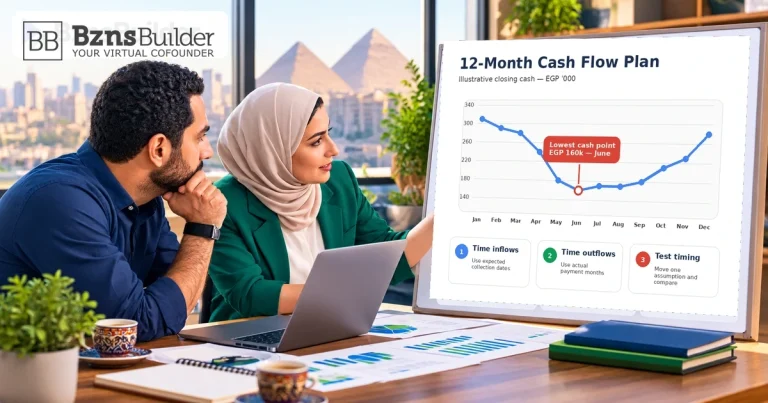
2. What is the lowest forecast cash balance?
Do not look only at the cash balance after the customer finally pays.
Find the lowest point before collection.
That is the point at which the contract puts the most pressure on your liquidity.
3. How much of that cash is already committed elsewhere?
The contract does not exist in isolation.
Your company may already need cash for payroll, rent, suppliers, loan repayments, tax or other projects.
A projected EGP 200,000 balance is not automatically safe or unsafe. It depends on what the business must pay from it.
4. What happens if the customer pays later than agreed?
A forecast based only on the contractual due date can be too narrow for a decision.
Test a delayed-collection case as well.
You are not predicting that the customer will pay late. You are asking whether the business can tolerate that outcome if it happens.
5. What does funding the gap cost or prevent you from doing?
A contract can consume cash even when its final contribution is positive.
If you need external financing to carry the gap, that may add financing cost.
If you use your own cash, the constraint may be different: less room to buy stock, hire, market, take another contract or absorb an unexpected expense.
The relevant cost is not always an interest rate. Sometimes it is the loss of flexibility elsewhere in the business.
6. Can you change another term instead?
The choice does not always have to be:
accept the customer’s requested terms or lose the deal.
Depending on the negotiation, you might explore:
- a deposit;
- milestone billing;
- partial upfront payment;
- staged delivery;
- a different price for a different payment structure;
- a smaller initial commitment before expanding the relationship.
These are negotiation options, not universal rules. The right structure depends on the contract, customer and bargaining position.
Negotiate the cash structure, not just the headline price
Founders often focus on the contract amount because that is the most visible number.
But a contract is also a schedule of cash commitments.
Two deals with the same invoice value can put very different pressure on the business if one requires you to carry the delivery cost for much longer.
Before conceding on payment timing, know what you are giving up:
- how much extra cash stays tied up;
- for how long;
- how low the bank balance falls;
- what other commitments compete for that cash;
- what happens if collection is delayed beyond the agreed date.
That gives you something concrete to negotiate around.
You may decide the larger contract is worth the temporary squeeze.
You may decide the business needs a deposit or milestone payment.
Or you may decide the contract is commercially attractive but too difficult to fund on the proposed terms.
The point is to make that decision from the cash path, not the contract headline.
How to test the contract decision in BznsBuilder
You can test this decision by putting the alternatives into a financial forecast.
BznsBuilder builds financial forecasts that include cash flow and lets you compare alternative assumptions through what-if scenarios.
Start with the forecast that reflects your current business.
Then create an alternative scenario that reflects the larger contract and its timing assumptions. Compare what changes in forecast cash and profit, and pay particular attention to the lowest cash balance before the customer payment arrives.
You can learn more about BznsBuilder’s Financial Forecasts & Scenarios.
If the contract only works when the cash timing works, compare the base case with the contract scenario before you commit. Start your 7-day free trial with BznsBuilder.
Decide on the cash trough, not the contract size
Longer customer payment terms are not automatically a reason to reject a bigger contract.
They are a reason to model it properly.
Work out:
- the cash you must commit before collection;
- the lowest cash balance before payment arrives;
- the other obligations that must be funded at the same time;
- the downside case if collection slips;
- whether another contract term can reduce the funding burden.
A large contract can be worth winning.
But the deal has to work between signing and getting paid, not only after the money finally arrives.