
What Is Cash Runway and How Do You Calculate It?

Cash runway is an estimate of how long your current cash can support the business before it runs out, given the rate at which the business is using cash. To calculate it, divide the cash you can use by your net monthly burn (cash out minus cash in). For example, $18,000 of cash ÷ $3,000 of net monthly burn = 6 months. Use the free cash runway calculator below to run your own numbers.
Key takeaways
- Cash runway = cash you can use ÷ net monthly burn. It tells you roughly how many months you have before cash runs out.
- Use net burn (cash out minus cash in), not total spending.
- If cash flow changes a lot from month to month, a month-by-month forecast shows the real low point better than one average.
The simple formula is:
Cash runway = Current cash balance ÷ Monthly net cash burn
If a business has $18,000 in available cash and is using $3,000 more cash than it generates each month, its simple runway is:
$18,000 ÷ $3,000 = 6 months
That is useful, but it is only a starting point. Real businesses rarely burn exactly the same amount every month.
Free cash runway calculator
Enter your monthly figures. It starts with the example used in this guide.
Your cash lasts about 6 months. See the month-by-month path, and test a hire or a late payment, in BznsBuilder.
Start free for 7 days · no credit cardThis assumes the same cash in and cash out every month. Real months vary, so use it as a first check, then build a month-by-month forecast. The calculation runs in your browser, and nothing you enter is sent or saved.
First calculate net cash burn
Net cash burn is the amount by which cash outflows exceed cash inflows during a period.
A simple monthly form is:
Net cash burn = Cash outflows − Cash inflows
Suppose a business collects $13,000 during the month and pays $16,000 in payroll, suppliers, rent, taxes and other cash expenses.
Its net burn is:
$16,000 − $13,000 = $3,000
If opening cash is $18,000 the shorthand runway is six months.
Illustrative example only. These figures are not benchmarks for any market.
Gross burn vs net burn
People use “burn rate” for two different numbers. Runway uses the second one.
| Measure | What it counts | In the example | What it tells you |
|---|---|---|---|
| Gross burn | All cash going out in a month | $16,000 | The size of your monthly cost base |
| Net burn | Cash out minus cash in | $3,000 | How fast your bank balance falls. Use this for runway. |
Dividing cash by gross burn understates runway, because it ignores the money customers pay you.
The formula stops being useful when burn is unstable
The simple formula assumes the recent burn rate is a reasonable guide to the future.
That can fail quickly.
A business may have:
- a tax payment next month;
- annual insurance due in one month;
- a new hire starting in two months;
- a seasonal sales peak;
- a delayed customer payment;
- equipment or fit-out spending;
- a loan repayment;
- a large deposit or supplier prepayment.
If cash flow changes materially from month to month, one average burn number hides the timing.
For that business, the stronger question is not “What is my average runway?” It is:
In which month does my forecast cash balance become uncomfortably low or negative?
Use a month-by-month forecast for a realistic runway
Imagine the same business starts with $18,000.
| Month | Net cash movement | Closing cash |
|---|---|---|
| Start | — | $18,000 |
| Month 1 | −$2,000 | $16,000 |
| Month 2 | −$3,600 | $12,400 |
| Month 3 | −$5,000 | $7,400 |
| Month 4 | −$1,600 | $5,800 |
| Month 5 | +$1,000 | $6,800 |
The average early burn suggests a declining cash position, but the business does not actually run out of cash in this five-month period. It starts recovering in Month 5.
Now change one assumption: a customer expected to pay $4,000 in Month 4 pays in Month 6 instead. Month 4 closing cash drops to $1,800.
The arithmetic did not change because of a different “runway formula.” It changed because timing changed.
That is why runway belongs inside a cash forecast.
If you are building that forecast for the first time, Business Forecasting: Creating Your First Financial Forecast Without Historical Data offers a practical starting point.
How many months of runway is enough?
There is no single right number. These are common planning rules of thumb, not benchmarks for any market:
| Your situation | Common rule of thumb | Why |
|---|---|---|
| Business that is burning cash | Act when runway falls below about 6 months | Cutting costs, raising prices or arranging finance all take time to work. |
| Startup planning to raise money | 12–18 months after a round; start raising with 6–9 months left | A funding round often takes several months to close. See how to secure funding. |
| Profitable business with no net burn | Watch the lowest forecast balance; keep a buffer for a few months of fixed costs | Late payments or a large bill can still create a short cash gap. |
Not open yet? Plan your starting runway as part of your startup budget: see how to estimate startup costs.
Cash runway is not the same as profit
A profitable business can have a short cash runway.
If you invoice customers today but collect later, the profit may appear before the cash arrives. If you buy inventory before selling it, pay staff before collecting invoices, or make capital purchases, cash can fall even when the business is profitable.
The opposite can happen too. A business can temporarily increase cash through a loan even while its operations are losing money.
If this distinction is the issue you are seeing, Sales Are Up. So Why Is Cash Going Down? explains the profit-versus-cash timing problem in more detail.
When should a founder recalculate runway?
Recalculate when the underlying cash outlook changes materially.
Useful triggers include:
- a major contract is won or lost;
- customer payment timing changes;
- a new hire is approved;
- rent or supplier prices change;
- funding is received;
- loan repayments start;
- a large asset purchase is committed;
- sales are materially above or below forecast.
For a business with volatile cash flows, reviewing the cash forecast monthly is usually more useful than relying on one static runway number.
What if the business is cash-flow positive?
If cash inflows consistently exceed outflows, “cash runway” as cash divided by burn no longer produces a meaningful positive month count because there is no net burn.
That does not mean cash risk disappears.
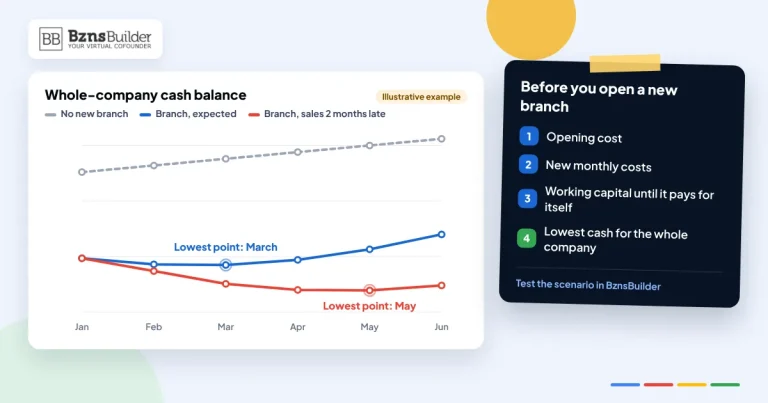
A cash-positive business can still face a temporary trough if a large payment comes before customer collections. In that situation, monitor the lowest forecast cash balance and the month in which it occurs.
That is often the more decision-useful measure for an established SME.
Use scenarios before making a commitment
Runway becomes more useful when you test the assumptions that can move it.
Create at least a base case and a downside case.
For example:
Base case
- customers pay on expected dates;
- planned sales are achieved;
- no unexpected large expense occurs.
Downside case
- sales are 15% lower for three months;
- a major customer pays 30 days later;
- supplier costs rise 8%;
- a planned hire still starts on schedule.
Then compare:
- lowest cash balance;
- month of lowest cash;
- whether cash becomes negative;
- how much extra funding or cost action would be needed.
The value is not predicting one exact future. It is seeing which assumptions make the business vulnerable.
Model cash runway in BznsBuilder
BznsBuilder is AI business planning and financial forecasting software for SMEs. Its forecast covers revenue, direct costs, staff, expenses, assets, financing and cash flow month by month, and what-if scenarios let you test other assumptions against your base case.
That means you can see the cash path behind a runway number, not just the average. A month-by-month financial forecast shows the month cash is lowest and what a hire, a price change or a late customer payment does to it.
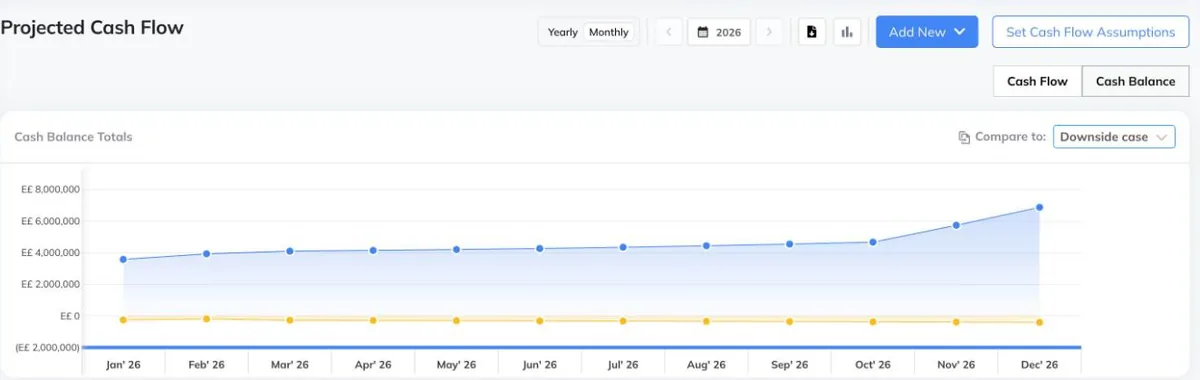
See how scenario comparison works in BznsBuilder →
See what a decision does to your cash before you commit. Start your 7-day free trial.
A practical runway checklist
Before you act on a runway number, check:
- Is the cash balance actually available?
- Are you using cash inflows and outflows, not accounting revenue and expenses?
- Is the burn period representative?
- Are taxes included?
- Are debt repayments included?
- Are equipment and other capital payments included?
- Are customer payment delays modeled?
- Are supplier-payment terms modeled?
- Have you tested a downside scenario?
- What is the lowest forecast cash balance, not just the average runway?
Cash runway is a useful warning measure. A cash forecast turns it into a decision framework.
Frequently asked questions
What is a good cash runway?
It depends on the business. A common rule of thumb is to act when runway drops below about six months, and for startups to aim for 12 to 18 months after raising money. A profitable business with no net burn should watch its lowest forecast cash balance instead.
What is the difference between burn rate and runway?
Burn rate is how much cash you lose each month. Runway is how many months your current cash lasts at that rate: cash divided by net monthly burn.
How do I calculate runway when my months are uneven?
Build a month-by-month cash forecast: opening cash, plus expected cash in, minus expected cash out, for each month. Your real runway ends in the first month the closing balance falls below zero, or below the minimum you want to keep.
Is cash runway the same as financial runway?
Usually yes; the terms are used interchangeably. Some people also count unused credit lines in financial runway. If you do, say so, because borrowed money has to be repaid.
How often should I recalculate my runway?
At least monthly, and whenever something big changes: a contract won or lost, a new hire, new funding, or a change in when customers pay.
Can a profitable business run out of cash?
Yes. If customers pay later than you pay suppliers and staff, or you buy stock and equipment upfront, cash can run out while the profit and loss statement shows a profit.
Know how many months of cash you have
Your runway updates as your plan changes.
- P&L
- Cash flow
- Scenarios