
Can My Business Afford to Open a New Branch? A Cash and Working Capital Test

Your business can afford a new branch if the whole company, not the branch on its own, can pay the opening cost, fund the new monthly costs until the branch pays for itself, and keep cash above a level you are comfortable with even if the branch’s income arrives late. So the real test is not “do we have the opening cost?” but “what is the lowest cash balance the company will reach?”
Key takeaways
- The opening cost is only part of it; new monthly costs start on day one.
- The branch needs working capital to fund the gap between its costs and its cash until it covers itself.
- Test the effect on the whole company’s cash, not the branch alone.
- Run at least one cautious scenario, such as branch income arriving two months late.
- If a loan funds the expansion, put the repayments in the same scenario.
The opening cost is not the only cost
The first number that comes to mind is the opening cost. It matters, but it is only half the picture.
Money you pay before opening
- Fit-out and furniture
- Equipment
- Opening stock, if you sell products
- Deposits and advance payments
- Any other set-up cost
To list these items first, see how to estimate startup costs for a small business.
Costs that start every month
- Salaries for the new team
- Rent and utilities
- Materials, suppliers and restocking
- Marketing and other running costs for the branch
The question is not “what are the company’s total costs?” but “which costs exist only because the branch opened?” That increase is what you compare with the extra cash the branch brings in.
How much working capital does a new branch need?
Working capital is the money that funds day-to-day operations. For a new branch it is simplest to think of it like this: monthly costs start straight away, but the cash the branch brings in builds up gradually. Someone has to fund that gap, the existing business’s cash, financing, or both.
Working capital the branch needs = the sum of (branch cash costs − branch cash contribution) for each month until the contribution covers the costs.
This is a practical calculation for the branch decision. The accounting definition (current assets − current liabilities) measures the company at one point in time, not what the branch needs during its start-up period.
In the example below the branch costs $7,000 a month in cash, and its contribution starts at zero and grows each month:
| Month | Gap: expected (USD) | Gap: cautious (USD) |
|---|---|---|
| Jan | 7,000 | 7,000 |
| Feb | 4,600 | 7,000 |
| Mar | 2,600 | 7,000 |
| Apr | 600 | 4,600 |
| May | — | 2,600 |
| Jun | — | 600 |
| Total | 14,800 | 28,800 |
So the same branch needs $14,800 of working capital if income arrives on time, and $28,800 if it is two months late, on top of the opening cost. This is the number most owners forget.
Worked example: one branch, two scenarios
All numbers are illustrative and only explain the decision; they are not averages or benchmarks for any market.
In the expected scenario the branch contributes nothing in January, then $2,400, $4,400, $6,400, $8,400 and $10,000. In the cautious scenario we change one assumption only: that contribution arrives two months later.
| Month | No branch (USD) | Branch: expected | Branch: cautious |
|---|---|---|---|
| Jan | 50,400 | 19,400 | 19,400 |
| Feb | 52,800 | 17,200 | 14,800 |
| Mar | 55,200 | 17,000 | 10,200 |
| Apr | 57,600 | 18,800 | 8,000 |
| May | 60,000 | 22,600 | 7,800 |
| Jun | 62,400 | 28,000 | 9,600 |
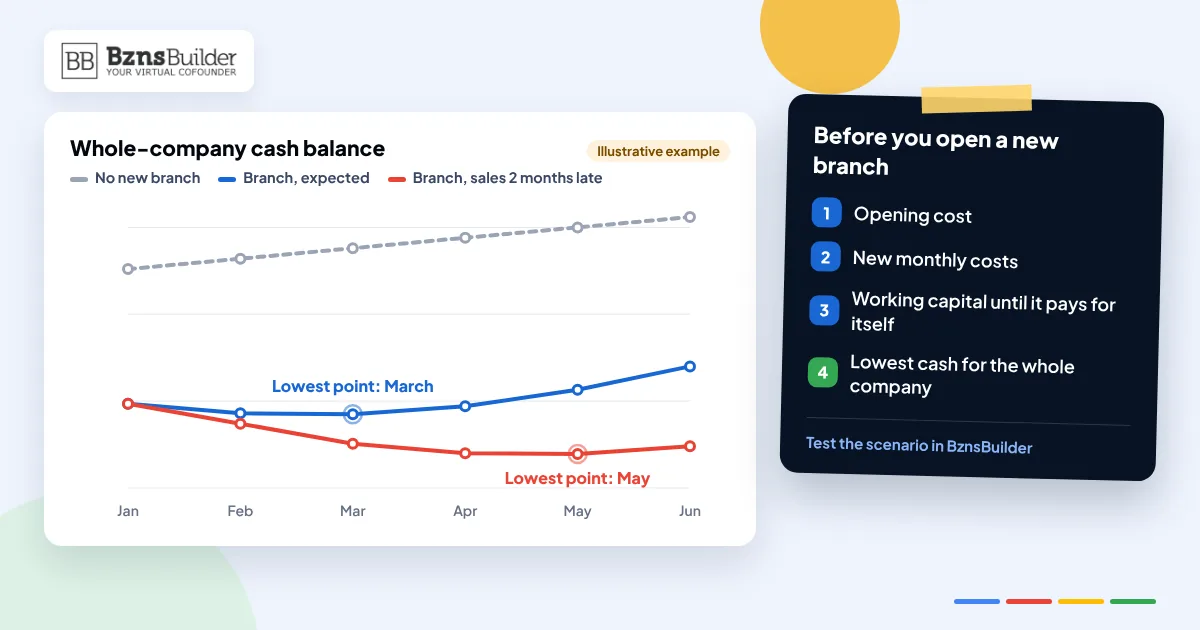
The company can pay the $24,000 opening cost. But in the expected scenario its cash falls from $48,000 to $17,000 in March before recovering. If branch income is just two months late, cash falls to $7,800 in May.
Same opening cost, same monthly costs, same core business. The only difference is the timing of branch income, and it cut the lowest balance by more than half. The example does not say $7,800 is “too low” or $17,000 is “safe”; the question is: does that balance fit your real commitments and risks?
Look at the whole company
Looking at the branch alone, you might say: “it will start earning and soon cover its costs.” But the opening cost and the start-up months are paid from the company’s cash. So put these in one table:
- Company cash before the decision
- Cash after the opening cost
- Extra costs month by month
- Contribution from the existing business
- Contribution from the new branch
- The lowest cash level under each scenario
Profit and cash answer different questions: a branch can be profitable in the long run and still squeeze cash in its first months. To build the full monthly picture, see how to build a 12-month cash flow forecast, and check your cash runway after the expansion.
4 steps to test the decision
- Count the cost of entryEvery payment needed before the branch opens, not just the biggest invoice.
- Count the new monthly loadCash costs that exist because of the branch, kept separate from the existing business.
- Write a clear income assumptionHow much will the branch contribute each month, and from when? Not “sales will be good”.
- Change one assumption at a timeDelay income by two months, or raise the opening or monthly costs, and see what happens to the whole company’s cash.
If the branch has no history yet, start with forecasting without historical data, and work out the branch’s break-even point.
If a loan funds the expansion
Financing changes when cash arrives, but it adds monthly repayments. Put the loan and its repayments in the same scenario instead of treating it as outside the calculation, and ask: after the expansion and the repayments, what happens to cash? This article does not recommend any bank or financing product.
Test the scenario in BznsBuilder
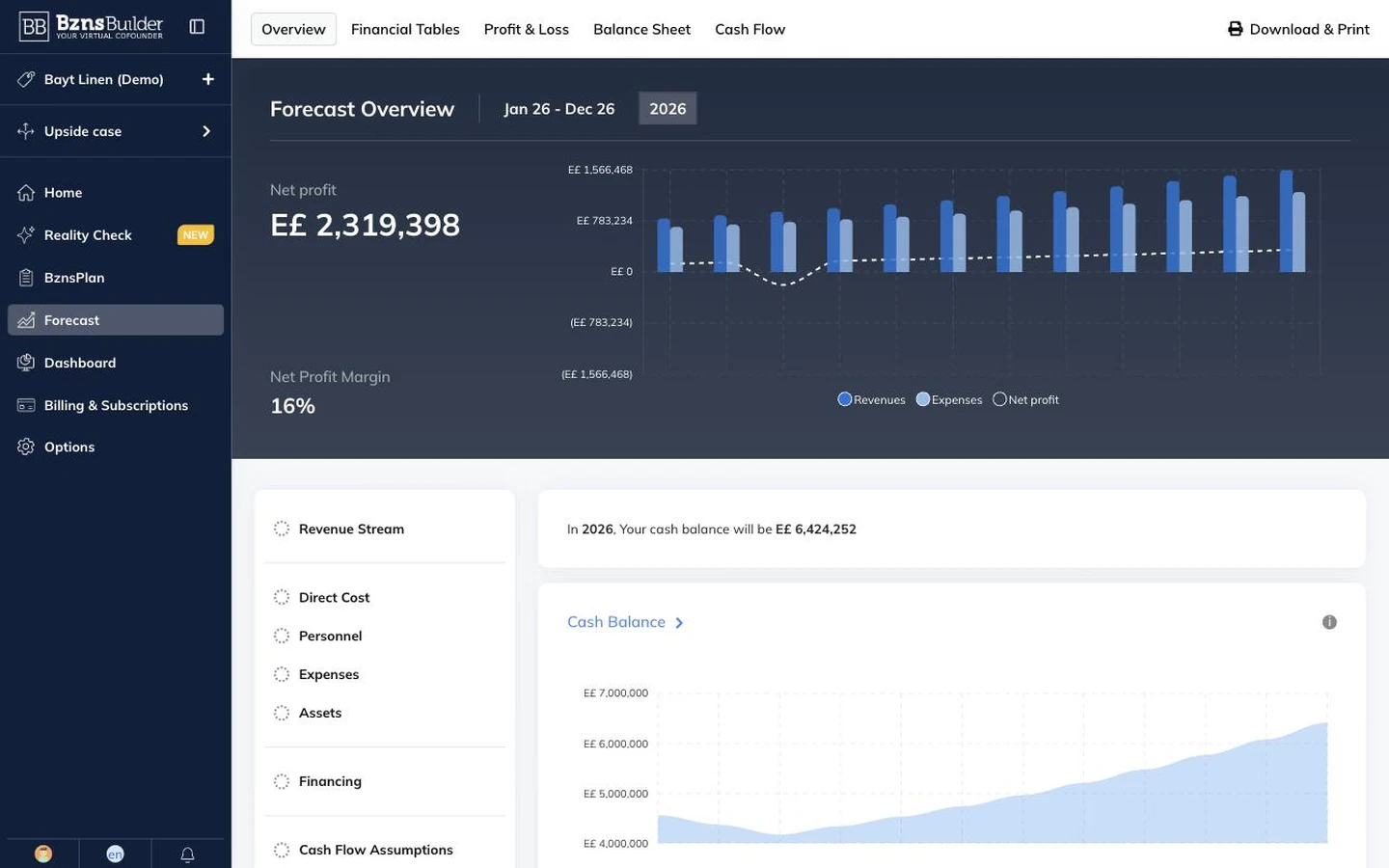
BznsBuilder builds a forecast with a profit and loss, balance sheet and cash flow statement, and lets you compare what-if scenarios: start with your current business, add the branch scenario, then a cautious one that delays branch income, and see the lowest cash balance in each before you commit.
See financial forecasts and scenarios →
Test the branch decision on your own numbers. Build your company forecast, compare the expansion with a cautious scenario, and see your lowest cash balance before you open.
FAQ
How do I know if my business can afford a new branch?
Work out the lowest cash balance the whole company reaches after the opening cost and the branch’s monthly costs, in an expected and a cautious scenario (for example, branch income two months late). If cash in the worst case still covers your commitments, the decision is financially workable.
How much working capital does a new branch need?
Add up the monthly gap between the branch’s cash costs and its cash contribution until the month the contribution covers the costs. In the article’s illustrative example: $14,800 in the expected case and $28,800 if income is two months late, on top of the opening cost.
How long does a new branch take to cover its costs?
There is no single answer for every business. Write your own month-by-month assumption, then test the same assumption two or three months later and see the effect on cash.
Should I fund the branch from cash or with a loan?
Either can work. Put your choice into the scenario: cash lowers the balance immediately, a loan adds monthly repayments. Compare the lowest cash balance in each case.
What is the difference between profitability and cash in an expansion decision?
Profitability says whether the branch earns money in the long run; cash says whether the company can pay its bills every month until then. A profitable branch can still squeeze cash in its first months.
The decision is yours — just make it on clear numbers. See what the branch scenario does to your cash before you sign the lease.
About the numbers: every figure in the example is illustrative and for explanation only, not an average or a market benchmark. This article is not financing or investment advice.