
Cash Flow Management and Forecasting for Small Businesses

Cash-flow management is not the same as checking how much money is in the bank today.
The useful question is forward-looking:
When will cash come in, when will it go out, and what is the lowest balance the business is likely to hit before the pattern changes?
That is where cash-flow forecasting becomes part of day-to-day management. A forecast turns expected receipts and payments into a running cash position. You can then use that view to decide whether a hire, inventory order, supplier payment, marketing commitment or growth plan fits the cash timing of the business.
If you only look backward, you learn what happened. If you forecast forward, you can decide what to do next.
Cash-flow management and cash-flow forecasting are different jobs
Cash-flow management is the ongoing work of controlling when money enters and leaves the business.
Cash-flow forecasting is the forward view that supports that work. It estimates expected cash inflows and outflows over future weeks or months and shows the resulting cash balance.
You need both.
A forecast with no management action is just a spreadsheet. Cash management with no forecast is mostly reaction.
This is also why profit, sales and cash should not be treated as interchangeable.
A sale can appear in your revenue before the customer pays. A cost can affect profit differently from the date the cash actually leaves the bank. A profitable month can therefore sit next to a tightening cash position.
If that timing gap is the problem you are seeing, read Sales Are Up. So Why Is Cash Going Down? for the deeper diagnosis.
For the broader financial-management picture beyond cash, see Managing Small Business Finances: How to Manage Them Effectively.
Build the cash view you can actually manage
A useful cash forecast does not need to start complicated. It needs to put the right cash in the right period.
1. Start with opening cash
Use the cash you expect to have available at the beginning of the period.
That becomes the starting point for the forecast. It is not revenue, profit or the value of unpaid invoices. It is the cash available to the business.
2. Put inflows where the cash is expected to arrive
Forecast collections based on timing, not just sales.
If you expect to invoice a customer in January but collect in February, the cash belongs in February’s cash forecast.
Depending on the business, inflows might include customer receipts, financing proceeds, owner contributions or other genuine cash receipts. The important point is to use the period in which the money is expected to become available.
3. Put outflows where the cash is expected to leave
Do the same for payments.
Payroll, suppliers, rent, inventory, loan repayments, equipment and other cash commitments belong in the period when you expect to pay them.
This is where many operating decisions become visible. Two expenses with the same total cost can create very different pressure if one must be paid immediately and the other is spread across several months.
4. Calculate the running closing balance
For each period:
Net cash flow = cash inflows − cash outflows
Then:
Closing cash = opening cash + net cash flow
The next period starts with the previous period’s closing cash.
That running balance matters more than looking at one month’s inflows and outflows in isolation. It shows where several decisions combine to create a cash low point.
Illustrative example: find the cash trough
Consider a fictional Egyptian SME starting January with EGP 600,000 in cash.
These figures are illustrative only. They are not a benchmark for Egyptian businesses.
| Month | Opening cash | Cash in | Cash out | Net cash flow | Closing cash |
|---|---|---|---|---|---|
| January | EGP 600,000 | EGP 400,000 | EGP 500,000 | -EGP 100,000 | EGP 500,000 |
| February | EGP 500,000 | EGP 450,000 | EGP 550,000 | -EGP 100,000 | EGP 400,000 |
| March | EGP 400,000 | EGP 650,000 | EGP 575,000 | EGP 75,000 | EGP 475,000 |
| April | EGP 475,000 | EGP 700,000 | EGP 600,000 | EGP 100,000 | EGP 575,000 |
The business finishes April with EGP 575,000. That number alone can make the forecast look comfortable.
But the more useful number is the lowest projected cash balance: EGP 400,000 at the end of February.
That is the point against which near-term commitments should be tested.
A new purchase may look affordable against April cash. It may be much less comfortable if payment falls before the February low point.
One timing change can alter the decision
Now change one assumption.
Suppose EGP 150,000 of the cash expected in February is collected in March instead.
Nothing else changes.
February cash inflow falls from EGP 450,000 to EGP 300,000. March inflow rises from EGP 650,000 to EGP 800,000.
The revised closing cash becomes:
- January: EGP 500,000
- February: EGP 250,000
- March: EGP 475,000
- April: EGP 575,000
By the end of March, the business is back at the same EGP 475,000 as the original forecast. By April, it still ends at EGP 575,000.
But the cash trough has changed from EGP 400,000 to EGP 250,000.
That EGP 150,000 timing shift did not change the eventual March or April cash balance. It changed how much liquidity the business needed to get there.
That is why cash-flow management is a timing problem as much as an amount problem.
Turn the forecast into operating decisions
Once the low point is visible, ask what is causing it and which decisions affect it.
Customer collections
If customer payments are arriving later than forecast, update the collection timing rather than leaving the original assumption untouched.
Then ask what happens to the lowest cash balance if the delay continues.
Supplier and payment timing
Map supplier payments to when they are actually due.
Do not assume that delaying payment is automatically the right answer. The point is to understand which commitments create the cash pressure, then evaluate commercially realistic alternatives.
Hiring
A hire is not only an annual salary number. It changes cash from the month the cost begins and may bring other related costs.
Before committing, put the timing into the forecast and inspect the months after the hire starts.
Inventory
Inventory can absorb cash before the related sale is collected.
Forecast when the inventory is purchased, when it is sold and when the customer cash is expected to arrive. The gap between those events can matter more than the gross margin when liquidity is tight.
Discretionary spending and investment
Marketing campaigns, equipment, expansion costs and other investments should be tested against the running cash balance, not only against expected annual profit.
The question is not simply, “Can the business pay for this?”
It is:
“What happens to the lowest projected cash balance if we make this commitment now?”
Use more than one scenario for important decisions
A single forecast can create false comfort because it hides how dependent the result is on one set of assumptions.
For material decisions, keep a base case and test at least one realistic alternative.
You might change:
- collection timing;
- sales volume;
- hiring date;
- inventory purchase timing;
- a major operating expense;
- financing timing.
The purpose is not to produce a dramatic worst case.
It is to learn which assumptions materially change cash and which do not.
A scenario that leaves annual profit almost unchanged can still create a much lower cash trough. That difference matters if bills, payroll or supplier commitments fall inside the gap.
If you are starting the wider forecast from scratch, Business Forecasting: Creating Your First Financial Forecast Without Historical Data covers the broader forecasting setup.
Keep the forecast alive
A cash forecast loses value when it becomes a document you build once and stop updating.
At each review:
- Replace forecast periods that have passed with actual results.
- Compare expected collections with what actually arrived.
- Compare expected payments with what actually left.
- Investigate material timing or amount differences.
- Update future assumptions.
- Extend the forecast so you still have a forward view.
This is not about making every forecast perfectly accurate.
It is about making the forecast useful enough to expose changes early and improve the next decision.
If a customer consistently pays later than assumed, the forecast should learn that.
If a supplier changes its terms, update the timing.
If hiring moves by two months, move the cost.
The forecast should follow the business rather than forcing the business to follow an outdated model.
Common cash-flow forecasting mistakes
Treating an invoice as cash
An invoice tells you what is owed. Your cash forecast needs to show when you expect the money to arrive.
Forecasting sales but not payment timing
Revenue growth can increase cash pressure when delivery costs are paid before customers pay you.
Leaving out irregular payments
Annual insurance, equipment purchases, financing payments or other non-monthly items can create a sharp cash drop if they are missing from the forecast.
Looking only at profit
Profit matters, but it does not tell you the timing of cash receipts and payments. Use profit and cash together.
Using only one scenario
The forecast should help you test decisions, not just document the current assumption.
Letting the forecast go stale
An old forecast can be worse than no forecast because it looks precise while describing a business that no longer exists.
Where BznsBuilder fits
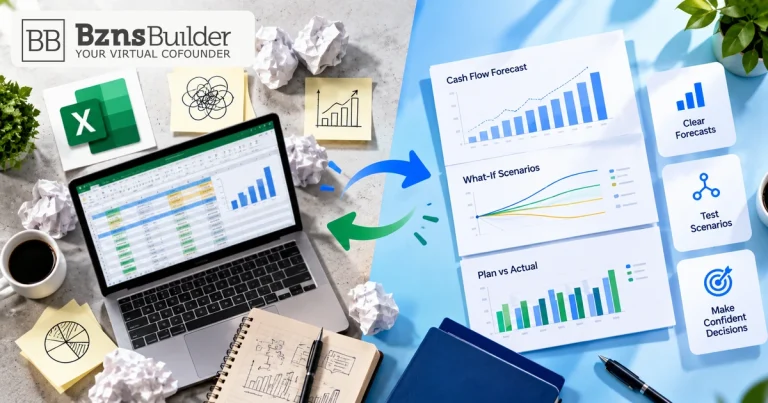
You can build this cash view manually in a spreadsheet.
BznsBuilder takes the same decision logic into a connected financial forecast. It builds forecasts covering P&L, balance sheet and cash flow, and lets you compare alternative assumptions through what-if scenarios. It can also track actual performance against the plan over time.
The useful part is not producing another report. It is being able to change an assumption and see how the forecasted cash and profit move together before you commit to the decision.
You can learn more about BznsBuilder’s Financial Forecasts & Scenarios.
Manage the low point, not just today’s balance
Good cash-flow management starts with one habit: stop asking only what the bank balance is today.
Ask what the balance is likely to become after the commitments already in motion.
Build the forecast around when cash is expected to arrive and leave. Find the lowest projected balance. Test important decisions against it. Then update the model when reality changes.
The forecast will never remove uncertainty.
It gives you a clearer place to make the decision.