
How to Build a 12-Month Cash Flow Forecast

A 12-month cash flow forecast answers a more useful question than “Will the business be profitable?”
It asks:
How much cash will we actually have, month by month, after the money comes in and the bills go out?
That distinction matters because sales, profit and cash do not move at the same time.
A customer can buy from you in March and pay in May. A supplier may need paying in April. Payroll still leaves the bank on schedule.
A useful cash flow forecast puts those movements on one timeline.
The basic calculation for every month is:
Opening cash + cash inflows − cash outflows = closing cash
Then the closing cash for one month becomes the opening cash for the next.
The arithmetic is simple. The difficult part is getting the timing assumptions right.
What should a 12-month cash flow forecast include?
At minimum, build six columns:
| Month | Opening cash | Cash inflows | Cash outflows | Net cash flow | Closing cash |
|---|
Behind those totals, keep the individual assumptions that create them.
For cash coming in, that might include:
- customer payments;
- cash sales;
- recurring contracts;
- other operating receipts;
- confirmed financing or owner funding, where applicable.
For cash going out, that might include:
- supplier payments;
- salaries and wages;
- rent;
- operating expenses;
- loan repayments;
- taxes when they are actually payable;
- equipment purchases;
- other planned cash commitments.
The important word is cash.
Do not automatically enter a March sale as March cash.
Enter the money in the month you realistically expect the customer to pay.
That is what turns a sales plan into a cash flow forecast.
Step 1: Start with the cash you actually have
Your first opening balance should be the cash available to the business at the start of the forecast.
For an established business, reconcile this with the relevant bank balances and any other immediately available business cash you intend to include.
Do not start with retained profit, revenue or accounts receivable.
Those are different numbers.
If your opening cash is EGP 350,000, the first line of the forecast begins with:
January opening cash: EGP 350,000
Everything after that flows from the assumptions underneath it.
Step 2: Forecast when customer cash will arrive
Start with the sales and invoices you expect, but then translate them into collection timing.
Suppose you expect to make EGP 500,000 of sales in April.
If EGP 150,000 is normally collected in May, April’s cash forecast should not pretend all EGP 500,000 arrives in April.
For existing businesses, useful evidence includes:
- current receivables;
- customer payment history;
- signed contracts;
- recurring orders;
- known payment terms;
- seasonal patterns.
For a new business without historical numbers, you will need explicit assumptions rather than false precision. Our guide to building your first financial forecast without historical data explains that broader process.
The principle is the same either way:
Forecast the receipt date, not merely the sale date.
Step 3: Put each cash outflow in the month it is paid
Now map the other side.
A forecast becomes misleading when expenses are smoothed into neat monthly averages even though the real payments are uneven.
If annual insurance is paid in March, put the cash outflow in March.
If equipment is bought in June, put it in June.
If a supplier allows 30 days before payment, reflect the actual payment month rather than automatically matching the cost to the sale.
This is where working-capital timing starts to appear.
Your business may make a healthy margin on a job but still have to fund payroll and suppliers weeks before the customer pays.
That timing gap is one reason sales can rise while cash falls.
Step 4: Calculate the month-by-month closing balance
Once the inflows and outflows are timed, calculate each month.
Illustrative 12-month example
Illustrative example only. All figures are fictional teaching numbers, not customer data, market benchmarks or claims about Egyptian SMEs. The monthly totals are only useful if they are supported by realistic collection dates, supplier terms, payroll timing and other payment assumptions for the business being forecast.
Imagine a small B2B business beginning January with EGP 350,000 in cash.
All figures below are shown in EGP thousands.
| Month | Opening | Cash in | Cash out | Net cash flow | Closing |
|---|---|---|---|---|---|
| Jan | 350 | 420 | 460 | -40 | 310 |
| Feb | 310 | 450 | 470 | -20 | 290 |
| Mar | 290 | 500 | 510 | -10 | 280 |
| Apr | 280 | 520 | 560 | -40 | 240 |
| May | 240 | 480 | 540 | -60 | 180 |
| Jun | 180 | 550 | 570 | -20 | 160 |
| Jul | 160 | 600 | 590 | +10 | 170 |
| Aug | 170 | 620 | 620 | 0 | 170 |
| Sep | 170 | 650 | 640 | +10 | 180 |
| Oct | 180 | 690 | 660 | +30 | 210 |
| Nov | 210 | 720 | 700 | +20 | 230 |
| Dec | 230 | 760 | 710 | +50 | 280 |
The business never runs out of cash in this base forecast.
But that is not the most useful conclusion.
The useful number is:
Lowest projected cash balance: EGP 160,000 in June.
That is the point where the business has the least room for an assumption to go wrong.
Step 5: Find the cash trough
The cash trough is the lowest projected cash position in the forecast.
Founders often look at December and conclude that the year looks fine.
In the example, December closes at EGP 280,000.
But the business has to survive June first.
That EGP 160,000 June balance is therefore more relevant to many decisions than the year-end number.
For example:
- Can the business commit to new equipment in May?
- Can it add another monthly payroll commitment?
- What happens if a large customer pays late?
- Is there enough room for an unexpected supplier payment?
- Would a growth plan increase the amount of working capital required before collections arrive?
A forecast should make those questions visible before the commitment is made.
Step 6: Stress the timing, not just the annual totals
Now test one assumption.
In the base forecast, May cash inflows are EGP 480,000.
Suppose a customer payment of EGP 120,000 expected in May is delayed until June.
Nothing has changed about the total amount collected across the two months.
Only timing has changed.
May becomes:
- opening cash: EGP 240,000;
- inflows: EGP 360,000;
- outflows: EGP 540,000;
- net cash flow: −EGP 180,000;
- closing cash: EGP 60,000.
Then the delayed EGP 120,000 arrives in June, bringing the later forecast back toward the original path.
The annual revenue assumption did not change.
But the lowest projected cash balance fell from EGP 160,000 to EGP 60,000.
That is why working-capital timing deserves its own test.
The business may still be profitable. The sale may still be good. The customer may still pay in full.
But the business has EGP 100,000 less cash at its weakest point.
That can change a decision.
Step 7: Build a base case and a downside case
You do not need twenty scenarios.
Start with two:
Base case: what you currently expect.
Downside case: one or two important assumptions move against you.
Depending on the business, test things such as:
- customer collections arriving later;
- sales collections being lower than expected;
- supplier payments happening earlier;
- payroll increasing;
- a major purchase moving forward;
- a seasonal slowdown lasting longer;
- a planned contract starting later.
Do not make the downside case dramatic just to make it look cautious.
Test plausible changes to assumptions that genuinely matter to your business.
Then compare the cash trough in each scenario.
Step 8: Turn the forecast into a rolling 12-month view
A 12-month forecast should not be built once and abandoned.
When January finishes:
- replace January’s forecast with what actually happened;
- investigate any material difference;
- update the assumptions for February onward;
- add a new month at the end so you still have 12 months ahead.
That keeps the forecast connected to the business you are actually running.
A forecast that said a customer would pay in 30 days should change if the customer is consistently paying in 50.
A cost assumption should change if the supplier has changed its price.
The objective is not to defend the original forecast.
It is to improve the next decision.
Common mistakes in a cash flow forecast
Treating invoices as cash
An invoice is not cash until the customer pays it.
Build collection timing into the forecast.
Forgetting irregular payments
Annual renewals, equipment purchases and other periodic costs can create sharp cash movements even when normal operating expenses look stable.
Making every month look the same
Seasonality, project timing and customer behaviour rarely produce twelve identical months.
Looking only at net cash flow
A month with positive net cash flow can still follow a dangerously low opening balance.
Keep the running closing balance visible.
Looking only at year-end cash
The company needs enough cash through every month, not only in December.
Find the lowest point.
Treating the forecast as a prediction you must get right
It is better treated as a model of your current assumptions.
When reality changes, change the model.
For a wider view of the numbers founders should keep together, see Managing Small Business Finances: How to Manage Them Effectively.
Spreadsheet or forecasting software?
A spreadsheet is enough to build the method described in this guide.
The important discipline is to make the assumptions visible and keep the monthly cash balance connected from one period to the next.
Where dedicated forecasting software becomes useful is when the cash forecast needs to remain connected to the rest of the financial model.
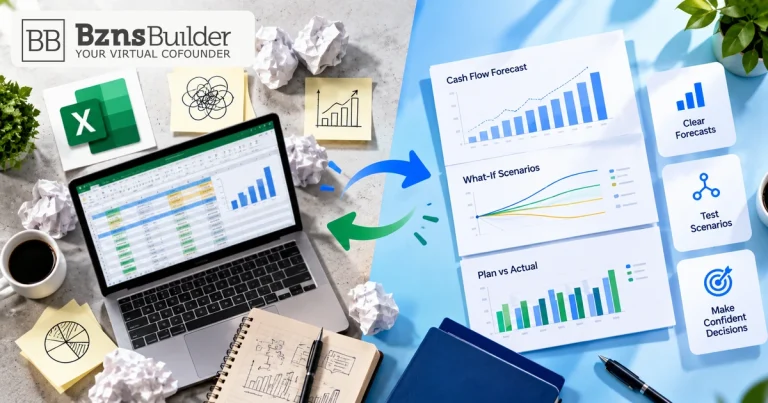
BznsBuilder builds financial forecasts across P&L, balance sheet and cash flow and lets you compare alternative assumptions using what-if scenarios.
You can learn more about BznsBuilder’s Financial Forecasts & Scenarios.
The point is not to produce a more impressive forecast.
It is to change an assumption and see whether the decision still works when the cash timing changes.
The number to watch is not December
A 12-month cash flow forecast is useful because it forces twelve months of decisions onto one timeline.
Build it in this order:
- start with actual opening cash;
- forecast when customer money will be collected;
- forecast when each cash commitment will be paid;
- calculate the closing balance month by month;
- identify the lowest projected cash balance;
- stress the assumptions that could move that low point;
- update the forecast with actual results and keep it rolling forward.
Do that, and the forecast becomes more than a financial table.
It becomes a way to see which decision is likely to put the most pressure on cash before you commit to it.