How to Price a Product: 3 Pricing Methods, Markup vs Margin and a Worked Example

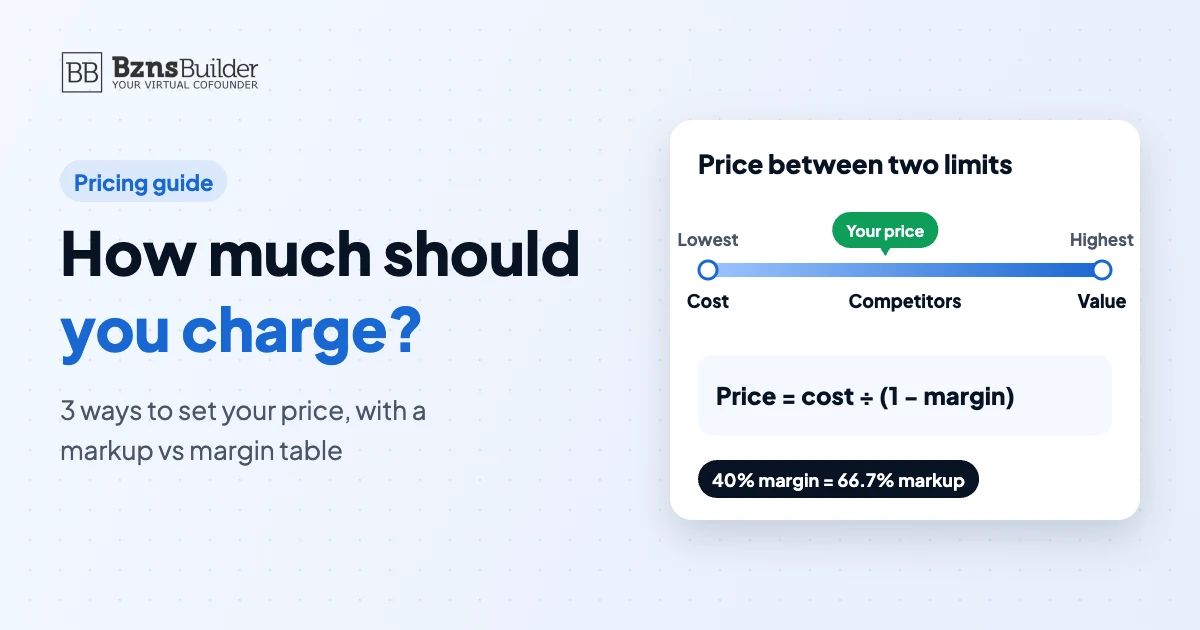
To price a product or service, start with its full cost per unit, then set a price between two limits: a floor that covers your cost and earns the margin you need, and a ceiling that customers will accept compared with competitors and with the value they get. The floor formula is: price = cost ÷ (1 − target margin). Example: a product with a full cost of $30 and a 40% target margin sells for $30 ÷ 0.6 = $50.
Key takeaways
- Start with the full cost per unit, including shipping, payment fees and a share of fixed costs.
- Margin is a share of the price, markup is a share of the cost. A 40% markup is not a 40% margin.
- Use all three methods together: cost sets your lowest price, competitors and value set the highest.
- Review prices whenever your costs change, and check the profit impact before any increase.
How to price a product in 4 steps
- Work out the full cost per unit: everything it takes to get one unit to the customer, plus its share of fixed costs.
- Set the margin you need: the share of the price you want to keep after costs.
- Check competitor prices: to see the range customers expect.
- Test the value to the customer: how much your product saves or earns them, and what they will pay.
Steps 1 and 2 give you your lowest acceptable price. Steps 3 and 4 give you your highest possible price. The right price sits between them.
Method 1: cost-plus pricing
This is the simplest and safest place to start, because it makes sure you never sell at a loss. The formula:
Price = full cost per unit ÷ (1 − target margin)
Worked example
An online store (hypothetical) sells a leather bag and sells 200 bags a month. All figures in the table are in USD.
| Cost item | Per bag |
|---|---|
| Materials and making | 15 |
| Packaging and shipping | 5 |
| Payment and marketplace fees | 5 |
| Share of fixed costs | 5 |
| Full cost per unit | 30 |
Each bag’s share of fixed costs = monthly fixed costs ($1,000 for rent, salaries and software) ÷ 200 bags = $5.
At a 40% margin: price = $30 ÷ (1 − 0.40) = $50.
Profit per bag: $50 − $30 = $20, which is 40% of the price.
Note that the share of fixed costs depends on how many you sell. At 100 bags a month, each bag carries $10 of fixed costs instead of $5. That’s why you should also calculate your break-even point at this price.
Markup vs margin: don’t mix them up
This is the most common pricing mistake. Both numbers describe the same profit, but from different starting points:
| Measure | Formula | In the example |
|---|---|---|
| Margin | (price − cost) ÷ price | 40% |
| Markup | (price − cost) ÷ cost | 66.7% |
So if you want a 40% margin and add only 40% to your cost, your real margin is 28.6%, not 40%. To get a 40% margin you need a 66.7% markup.
To convert between them: markup = margin ÷ (1 − margin), and margin = markup ÷ (1 + markup).
| Target margin | Markup needed on cost |
|---|---|
| 10% | 11.1% |
| 20% | 25% |
| 25% | 33.3% |
| 30% | 42.9% |
| 40% | 66.7% |
| 50% | 100% |
| 60% | 150% |
Method 2: competitor-based pricing
Here you start from market prices instead of your cost. Collect prices from 5 to 10 competitors selling to the same customer, and note the range from cheapest to most expensive.
In the example, if similar bags sell for $45 to $60, the cost-based price of $50 sits inside the range, and you can choose your position in it based on your quality and service.
If competitors sell below your cost-based floor, don’t follow them down by default. Lower your cost, offer a clear advantage that justifies a higher price, or rethink the product.
Method 3: value-based pricing
Here you ask: what is your product worth to the customer? It suits services, software and differentiated products, where the value to the customer can be far higher than your cost.
Example: a service that saves a small business $200 a month in time or errors. A price of $50 a month looks like an easy deal to the customer, even if it costs you much less to deliver.
To find the value, ask your current customers: what problem does your product solve? What were they paying before? At what price would it start to feel expensive?
| Method | When to use it | Risk |
|---|---|---|
| Cost-plus | The starting point for every product, and to know your lowest acceptable price | Leaves money on the table if your value is higher |
| Competitor-based | Markets with similar products where customers compare easily | Copies prices that may not cover your costs |
| Value-based | Services and differentiated products that solve a clear problem | Needs a good understanding of your customers and proof of value |
Common pricing mistakes
- Forgetting small costs: payment fees, shipping, returns, and marketplace or delivery-app commissions.
- Mixing up markup and margin: you think you earn 40% when you earn 28.6%.
- Undercutting competitors without a plan: a lower price needs a lot more sales to make up for it.
- One price for every channel: selling through a platform that takes a commission needs a different price from selling direct.
- Never reviewing prices: if costs rise and your price doesn’t, your margin shrinks without you noticing.
After you set your price
Pricing is a decision you keep making, not a one-off. Once you have a price:
- Calculate your break-even point to see how many sales you need each month.
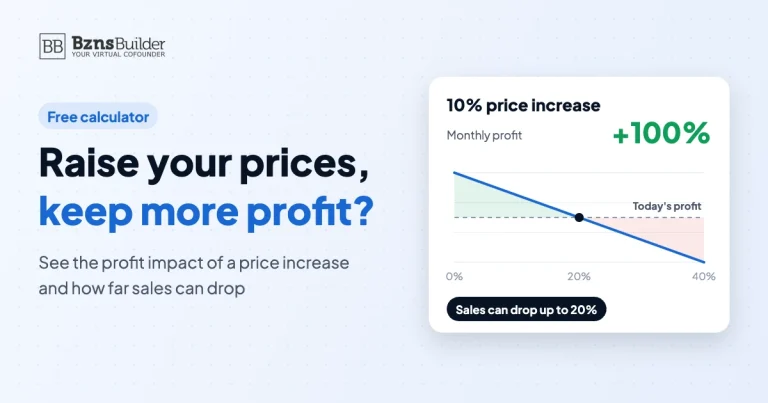
- When you consider raising prices later, use the price increase calculator to see the profit impact and how far sales can fall.
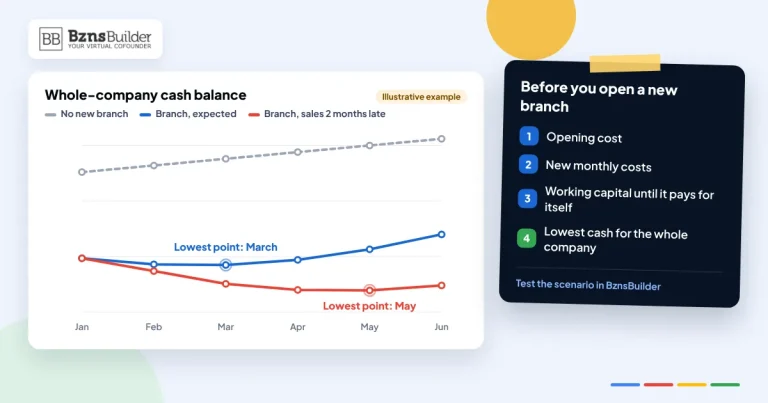
- Put the price into a 12-month cash flow forecast to see when the money actually reaches your account.
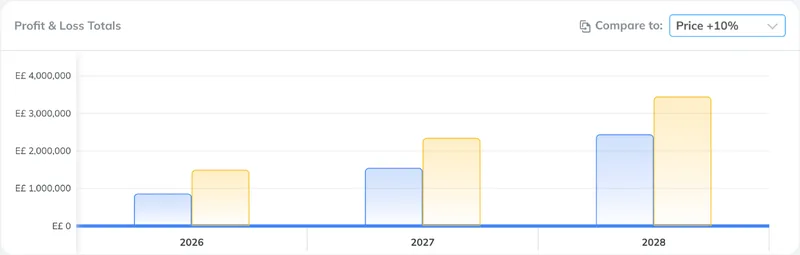
In BznsBuilder, you enter your prices and costs in your financial forecast once, then try a different price in a new scenario and see its effect on your profit and loss, cash flow and balance sheet month by month.
Test your prices on your financial forecast. Start your free 7-day trial.
Pricing FAQ
How do I price a product?
Work out the full cost per unit, then divide it by (1 − your target margin) to get your lowest acceptable price. Then compare with competitor prices and with the value customers get, and choose a price between the two. Example: a $30 cost and a 40% margin give a price of $50.
What is the difference between markup and margin?
Margin = profit ÷ price, and markup = profit ÷ cost. In the example, a $20 profit on a $50 price is a 40% margin, but a 66.7% markup on the $30 cost.
What profit margin should a small business aim for?
There is no single right number; it varies a lot by industry. Start from the margin that covers your fixed costs and leaves a profit at the sales volume you expect, then check that the resulting price works in your market. Remember that a 40% margin needs a 66.7% markup, not 40%.
Should I price lower than my competitors?
Not before you run the numbers. A lower price cuts your profit on every unit, so you need many more sales to make up for it. Compete on quality, service or speed first, and make a lower price a calculated decision rather than a reaction.
How often should I review my prices?
Whenever your costs change noticeably, and at least every 6 months. Before any increase, check how far sales can fall before your profit drops.
Put your prices into a 12-month plan
See profit and cash month by month, in minutes.
- P&L
- Cash flow
- Scenarios