Budget vs Forecast: Key Differences and What Matters Most

Budget vs forecast: a budget is the plan you commit to for a fixed period, usually a year: your revenue targets and spending limits. A forecast is your best current estimate of what will actually happen, and you update it every month or quarter as real results come in. The budget shows where you planned to go, the forecast shows where you are heading, and comparing both with your actual results tells you what to change.
Key takeaways
- A budget is a target and a spending limit; a forecast is an expectation that changes when the facts change.
- Budgets are usually set once a year. Forecasts are updated monthly or quarterly, often as a rolling 12-month view.
- Use them together: budget vs actual shows how far you are off plan, and the forecast shows where the year will land.
- For a small business, start with a monthly forecast that covers profit and cash, then set budget limits from it.
Many owners use “budget” and “forecast” as if they mean the same thing. They do not, and mixing them up leads to a common problem: a business keeps measuring itself against a plan that stopped being realistic months ago, while the cash position quietly moves in another direction.
This guide explains the difference in plain terms, shows a side-by-side comparison, and walks through a worked example of budget vs forecast vs actual, so you can see how the three numbers work together in a real monthly review.
Both usually start from the same input: a monthly sales forecast built from units and prices.
Budget vs forecast: the differences at a glance
| Aspect | Budget | Forecast |
|---|---|---|
| What it is | A plan: the results you are aiming for and the money you allow yourself to spend | A prediction: the results you now expect, based on the latest information |
| Question it answers | “What do we want to achieve, and what can we spend?” | “Where are we actually going to end up?” |
| Time frame | A fixed period, usually one financial year | Often the next 12–18 months, rolled forward each month or quarter |
| How often it changes | Set once; rarely changed during the year | Updated regularly as actual results come in |
| Level of detail | Detailed, line by line, often by department or cost centre | Focused on the drivers that move results: sales volume, price, margin, headcount, collections |
| Main use | Allocating resources, setting limits and holding people accountable | Making decisions early: hiring, stock, pricing, funding and cash planning |
| Compared with actuals? | Yes, in a budget vs actual (variance) report | Yes, and the forecast is then updated for the rest of the period |
| When reality changes | Stays as the benchmark you are measured against | Changes to show the new expected outcome |
In short: a budget is about control, and a forecast is about direction. As AccountingTools puts it, a forecast is an estimate of what will actually happen and is updated often, while a budget is what management wants the business to achieve.
What is a budget?
A budget is a financial plan for a set period. It lists the revenue you expect to earn and, more importantly for most small businesses, the limits on what you can spend: salaries, rent, marketing, stock purchases and so on.
A budget is useful because it turns goals into numbers that people can work to. If the marketing budget for the quarter is $6,000, everyone knows the ceiling before money is committed. At the end of each month you compare what you actually spent and earned with the budget, and the gaps (variances) show where to look.
Its weakness is that it is fixed. A budget agreed in December does not know that a major customer will pay 60 days late in March, that a supplier will raise prices, or that the currency will move. The budget still has value as a benchmark, but it stops being a reliable picture of where the year will end.
What is a financial forecast?
A financial forecast is your best estimate of future results, based on what you know today: recent actuals, your sales pipeline, prices, costs and the market. It is a prediction, not a promise, and it is meant to change.
A complete forecast covers the three financial statements, because each one answers a different question:
- Profit and loss: will the business make money over the period?
- Cash flow: will there be enough cash in the bank each month to pay the bills? (Profit and cash flow are not the same thing.)
- Balance sheet: what will the business own and owe at the end of the period?
Good forecasts are built from drivers rather than from last year’s totals plus a percentage. For example, revenue = number of orders × average order value; payroll = headcount × cost per person. When a driver changes, you update one input and the whole forecast moves with it. If you are starting from zero, see how to forecast without historical data.
Budget vs forecast vs actual: how the three work together
The three numbers answer three different questions:
- Budget: what did we plan?
- Actual: what really happened?
- Forecast: given what has happened, where will we end up?
The comparison that matters most in a monthly review is not only budget vs actual. It is what the gap means for the rest of the year, and that is the forecast’s job.
Worked example: an online store after its first quarter
Illustrative example only. All figures are fictional and are not benchmarks for any market or sector.
An online store set an annual budget of $120,000 in revenue ($10,000 a month), a 55% gross margin, a marketing budget of $2,000 a month and fixed costs of $3,000 a month. That budget delivers $6,000 of operating profit for the year.
After the first quarter, sales are 10% below budget and marketing spend is 10% above it. The owner updates the forecast, assuming monthly revenue of $9,400 for the rest of the year and marketing back on budget:
| USD | Annual budget | Q1 budget | Q1 actual | Q1 variance | Full-year forecast (after Q1) |
|---|---|---|---|---|---|
| Revenue | 120,000 | 30,000 | 27,000 | −3,000 | 111,600 |
| Gross profit (55%) | 66,000 | 16,500 | 14,850 | −1,650 | 61,380 |
| Marketing | 24,000 | 6,000 | 6,600 | +600 over | 24,600 |
| Fixed costs | 36,000 | 9,000 | 9,000 | 0 | 36,000 |
| Operating profit | 6,000 | 1,500 | −750 | −2,250 | 780 |
What the three views tell the owner:
- Budget vs actual says Q1 missed by $2,250 of operating profit. Useful, but it only looks back.
- The forecast says that if nothing changes, the year ends at about $780 of operating profit instead of $6,000. That is the number that should drive decisions.
- The decision is now clear: find out why sales are short (traffic, conversion or order value), check whether the extra marketing is paying back, and test the options before committing more spend.
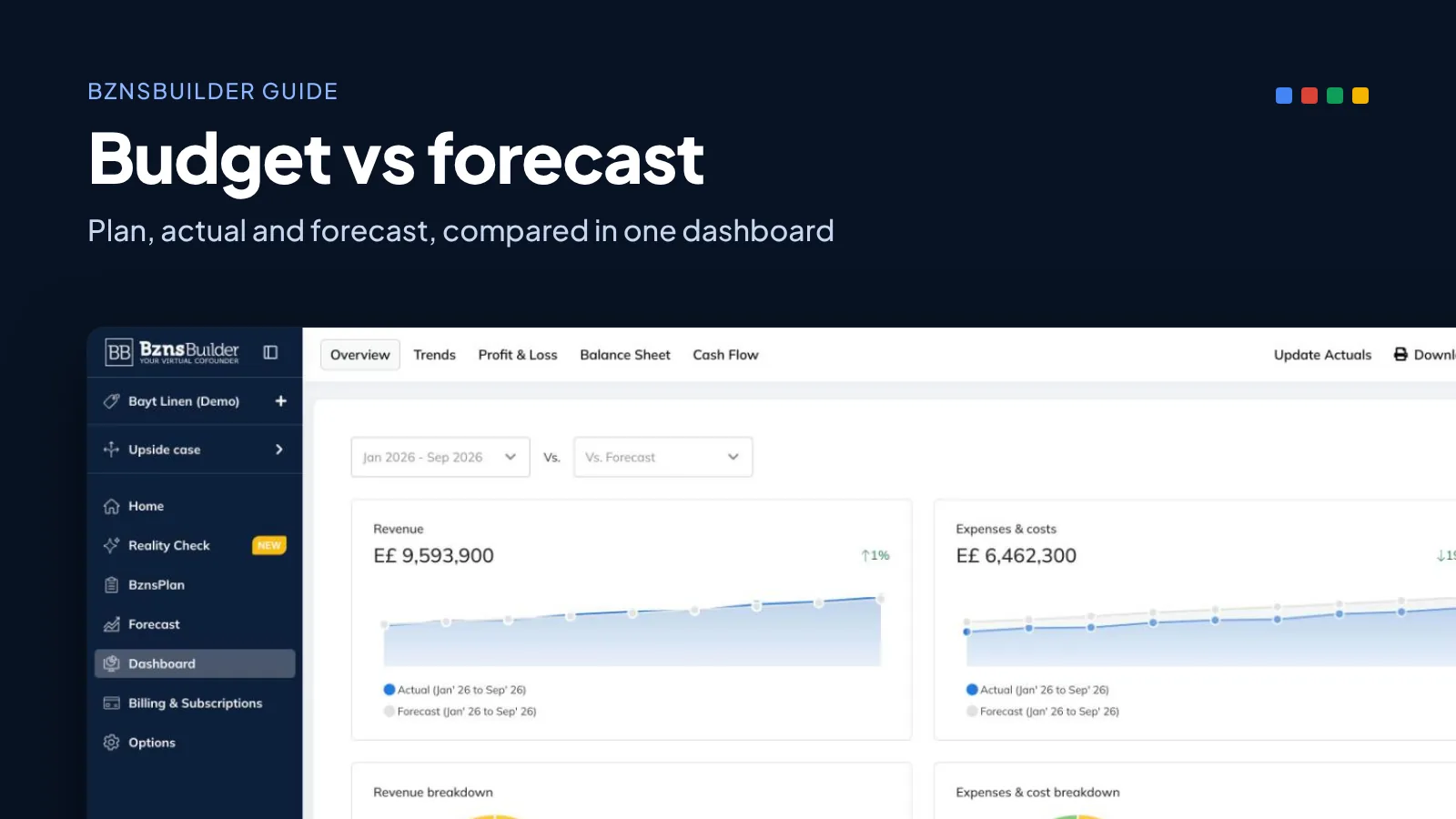
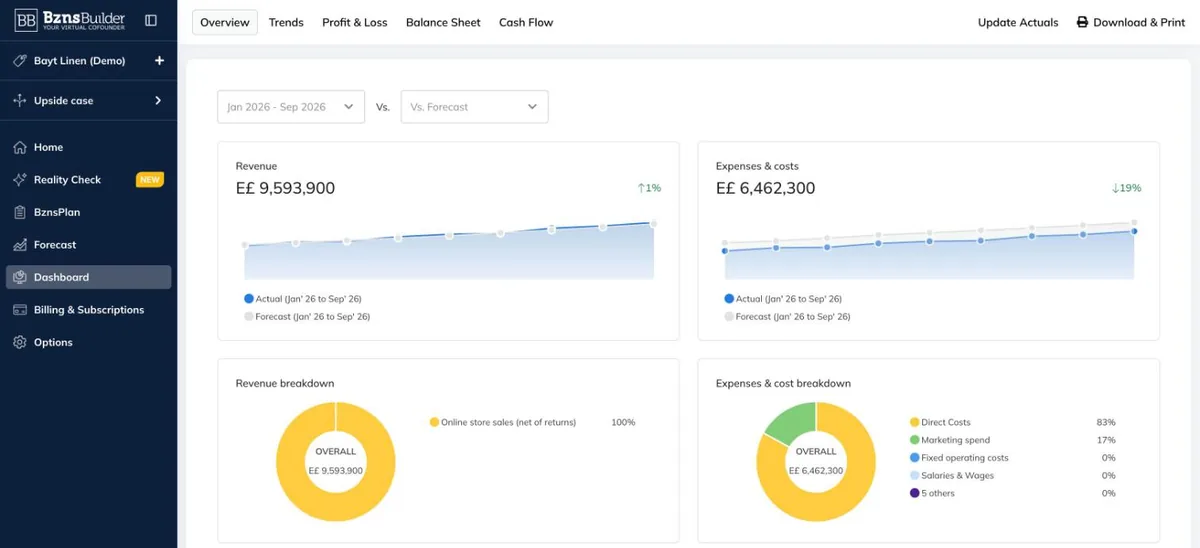
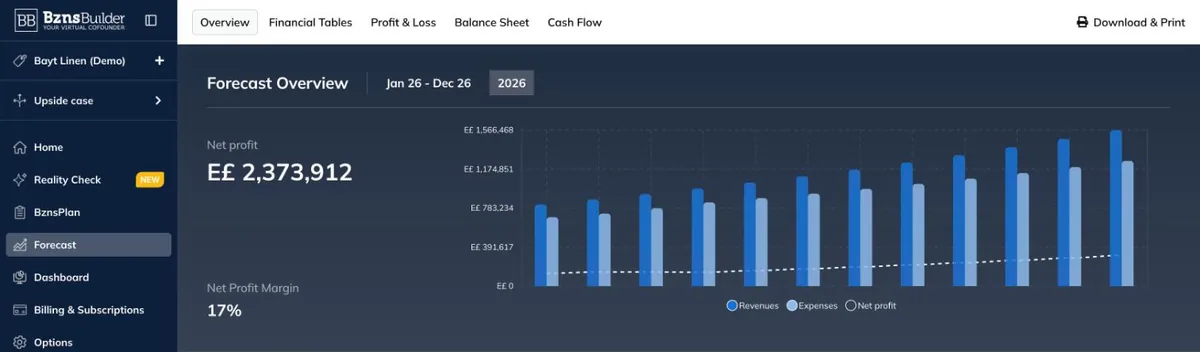
Here is the same kind of comparison in BznsBuilder. The dashboard shows actual results next to the forecast for any period you pick, so the gap is visible as soon as a month closes.
Build this view for your own business in BznsBuilder →
Notice that the owner did not rewrite the budget. It stays as the benchmark for the year. The forecast is what moved. For a step-by-step method to read and act on these gaps, see our guide to plan vs actual analysis.
Rolling forecasts and reforecasts: keeping the forecast current
A reforecast is simply an update of the forecast for the rest of the period, using actual results to date. The example above is a reforecast after Q1.
A rolling forecast goes one step further: every time a month closes, you add a new month at the end, so you always look 12 (or 18) months ahead instead of only to the end of the financial year. That stops the “cliff” where, by October, your forecast only covers two more months.
Update the forecast at least monthly, and straight away when something material changes, for example:
- you win or lose a large customer or contract;
- a supplier changes prices or payment terms;
- the exchange rate moves enough to change your costs or prices;
- you plan a hire, a new branch or a large stock purchase;
- a seasonal period such as Ramadan, summer or back-to-school behaves differently from what you assumed.
Because the forecast includes cash, a monthly update also tells you how many months your cash will last. If that number is getting shorter, calculate your cash runway before it becomes urgent.
Forecast vs projection: are they the same?
They are close, and many people use them interchangeably. The useful distinction is this: a forecast is what you expect to happen, while a projection is what would happen under a specific assumption, a “what if”. “If we raise prices by 8% and lose 5% of customers, revenue will be…” is a projection. Running several projections side by side is scenario planning, and the most likely one becomes your forecast.
Do small businesses need a budget, a forecast or both?
Both, but in this order:
- Build a monthly forecast first. Cover revenue drivers, costs, profit and cash for the next 12 months. A 12-month cash flow forecast is the most important part for a small business, because running out of cash is what stops a business, not a weak quarter on paper.
- Set your budget from the forecast. Once you know what is realistic, turn it into targets and spending limits for the year.
- Review every month. Compare actuals with the budget, explain the material variances, then update the forecast for the remaining months.
- Decide, then act. Use the updated forecast to decide on hiring, stock, pricing and funding before the gap shows up in your bank balance.
Common mistakes to avoid:
- Treating the budget as the forecast and never updating it.
- Forecasting profit but not cash.
- Forecasting at too much detail, so updates take days and stop happening.
- Changing the budget every time results miss, so there is no fixed benchmark left to learn from.
Before you set targets, it also helps to know the sales level that covers your costs. Our break-even point guide and calculator shows how to work it out.
How to run your forecast, budget and actuals in BznsBuilder
BznsBuilder is AI business planning and financial forecasting software for SMEs. It builds your forecast with the three statements (P&L, cash flow and balance sheet) linked automatically, so changing one driver updates profit and cash together.
Want to see it before you sign up? Take the interactive product tour.
- Test before you commit: create what-if scenarios to compare assumptions, such as lower sales or a price change, side by side. See financial forecasts and scenarios.
- Compare plan with actual: the performance dashboard compares planned and actual results, and actuals can be entered manually.
- Stay out of spreadsheets: no formulas to maintain. If you are deciding between tools, see forecasting software vs Excel.
Build your first forecast and compare it with your budget. Start your 7-day free trial with BznsBuilder. No credit card is needed.
Frequently asked questions
What is the main difference between a budget and a forecast?
A budget is a plan: the targets and spending limits you set for a fixed period. A forecast is a prediction of what will actually happen, updated as new results and information come in. The budget stays fixed as a benchmark; the forecast changes.
Can a forecast replace a budget?
Some businesses run on rolling forecasts alone, but most small businesses benefit from both. The budget gives you a fixed target and spending limits; the forecast tells you early whether you will hit them, so you can act in time.
How often should you update a forecast?
At least once a month, after you close the month’s numbers, and immediately when something material changes, such as losing a big customer, a price change from a supplier or a large exchange-rate move.
What is budget vs forecast vs actual?
It is a three-way comparison: the budget is what you planned, the actual is what happened, and the forecast is where you now expect the period to end. Budget vs actual shows the variance to date; the forecast shows what that variance means for the full year.
What is a rolling forecast?
A rolling forecast always looks the same distance ahead, for example 12 months. Each time a month closes, you replace it with actuals and add a new month at the end, instead of forecasting only to the end of the financial year.
Is a forecast the same as a projection?
Not quite. A forecast is the outcome you expect. A projection shows what would happen under a specific assumption, a “what if”. Comparing several projections is scenario planning, and the most likely scenario becomes your forecast.